
INTRAC and local partners are undertaking a one-year project to understand and strengthen the ecosystem of support to civil society organisations (CSOs) in Brazil, Colombia, Mexico, China, and Japan. Throughout the project, there is a specific focus on building effective, legitimate, and resilient climate focused organisations in these contexts.
Understanding civil society support ecosystems
Strong, dynamic civil society support ecosystems can support CSOs to increase their impact and play an essential role in societal advancement. A civil society support ecosystem may also be termed as its infrastructure. Consultants, intermediary or infrastructure organizations, re-grantors, and a host of other actors have an important role to play in the ecosystem. For the purpose of this project, we have defined infrastructure actors as those who work with CSOs to help them find solutions to their organisational development (OD) challenges.
Healthy ecosystems have a balance between demand for services and supply of quality services, where there is awareness of and equal access to infrastructure actors and appropriate support and an enabling environment for these actors. A key part of the support ecosystem is its consultancy market. Alongside the contextual dynamics influencing supply and demand across the support ecosystem, this project also explores the challenges, needs, and realities for independent, local consultants.
There is an increasing understanding of the importance of approaches and support that are rooted in local culture, practice, and knowledge, with appropriate and ethical ways to connect and engage across regions and globally. Such conditions are another indicator of healthy support ecosystems that are more resilient to internal and external shocks and that have more equitable power balances between different actors and across regions.
A phased approach
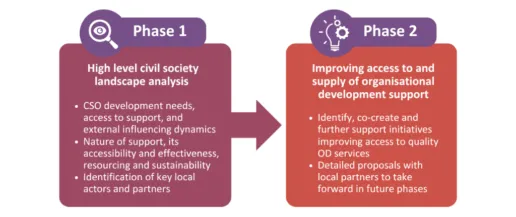
The project has two phases:
Phase 1
The first phase took place between October 2024 and March 2025. INTRAC undertook a high-level landscape analysis that examined the strengths and challenges of the ecosystem of support for CSOs in the five countries. Drawing on 117 interviews with CSOs, consultants, intermediary and infrastructure organisations and others, it provided a high-level analysis of the development needs of CSOs, their access to support and the relevant factors of their operating context, and understanding of the support ecosystem, how it responds to CSO demand and needs, and how it is sustained and resourced.
The findings and recommendations of this analysis are aimed at donors and practitioners interested in investing and working in these civil society support ecosystems, that can be used to inform approaches within such dynamic contexts in the immediate and longer term.
Access the country-level and consolidated reports
The five country level reports for Brazil, Colombia, Mexico, China, and Japan – as well as the consolidated report – are available to download.
Phase 2
In the second phase, running until October 2025, INTRAC is working with local stakeholders to co-create initiatives in each country that build on findings from the landscape analysis. The recommendations from Phase 1 have been distilled into two broad, overlapping areas:
1: Understanding and improving access to and supply of OD support at country level
Phase 1 identified a common challenge for CSOs in accessing appropriate OD support, reflecting support ecosystems that are often fragmented and lack coordination and effective communication. It also identified various initiatives working to strengthen access to services and to improve coordination and communication among infrastructure actors. In this phase we are developing a deeper understanding of access issues. Concrete opportunities are being identified and developed that seek to strengthen access to, the coordination, communication and mobilisation of the consultancy market and service provision among other infrastructure actors, ultimately contributing to improved OD supply and demand.
2: Strengthening the quality of OD support from national consultants and infrastructure organisations
Phase 1 highlighted the challenge for many countries of underdeveloped consultancy markets, with varying, fragmented OD provision. There is a broad, diverse need for relevant and effective support across a range of organisational development topics for CSOs. The challenge is compounded by a lack of appropriate training opportunities for consultants and also opportunities for them to connect and learn with peers. Through deeper learning conversations, phase two is exploring the specific professional development needs of consultants and infrastructure organisations, so they are better able to provide quality OD support to CSOs.
Looking forward
Discussion is taking place with a range of foundations to co-finance pilot initiatives in a third phase, beyond October 2025. These are intended to be scalable to increase their impact and sustainability.