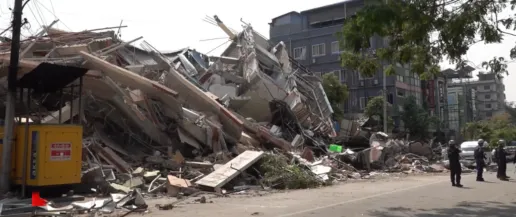
Screenshot of a video from China News Service that shows damage in Mandalay in the aftermath of the earthquake of 28 March 2025; shared under the CC-BY-3.0 license.
Civil society in Burma* has provided essential services to communities amidst the most challenging circumstances, during conflict, natural disasters and with little and fluctuating international support. Ko Lin* talks to Paul Knipe about how civil society in Burma remains steadfastly resilient and what we must learn from it.
Hours after a 7.7 magnitude earthquake hit Burma, levelling towns and villages and killing thousands, the Tatmadaw (State military) resumed its bombing offensive against pro-democracy and ethnic armed groups.
Ko Lin, like many civil society activists, is based in the Burma-Thailand border regions and has been tirelessly supporting and coordinating relief efforts while lobbying in support of pro-democracy movements and the National Unity Government. “Civil society responded to the earthquake immediately. Despite the challenges, CSOs were the first to support rescue and relief operations,” he reflects. “The situation in Saigang [the earthquake epicentre] was very bad. Many historic sites and buildings were destroyed and bodies were everywhere. Yet still the State continues its military strikes, continuing the war against the civilians”.
The Burma earthquake compounded huge challenges that civil society face in the country, against a backdrop of civil war, restrictions under the military regime, and economic turmoil. “Our economy and infrastructure are not good. Getting clean water and medicine to those affected was a challenge. Roads and communications are broken. The security situation means many civil society groups are monitored and restricted.”
Young adults have been particularly affected, given the 2024 conscription law making it mandatory for them to join the army for 2-5 years. As a result, many are either conscripted to the military or join the diaspora in exile. Yet, as has so often been the case in Burma’s history, civil society has adapted and flexed and found innovative ways to overcome challenges. “The young generation are capitalizing on technology, using AI, social media, to immediately support the earthquake response”, says Ko Lin, highlighting the live action Earthquake Rescue Resources site that was quickly launched after the quake. This uses AI and social media to track statistics, signpost and provide essential information in Burmese on missing persons, relief services, and other areas. Using technology in this way has provided essential support, without the need to be physically present.
The earthquake hit at a time of shifting dynamics and geopolitics among international governments, affecting aid and humanitarian efforts. Ko Lin feels the uncertainty and reduced funding among pro-democracy governments has added to the challenges and dilemmas civil society already faced. Should civil society, especially those fighting for pro-democracy solutions, cooperate with authoritarian regimes? While quick to provide funding and infrastructure, these are also more likely to prop up the Burmese military rulers. “Now the international climate is changing. What is the motivation, what is the expectation? We don’t know.” Ko Lin reflects. “We do what we can and coordinate with them. We are seeing two broad communities, internationally: the pro-democracy, people-centered approach [of Europe, US]; and the ASEAN countries, along with China and Russia. This second group was the first to send rescue teams and humanitarian aid but are working closely with the military regime.
“Every year there are natural disasters and conflict. Always there are challenges to our people, but we are people of Burma and we will always respond.”
This dilemma speaks to an element at the heart of civil society’s enduring resilience in Burma: political motivation and activism. While civil society in Burma has a strong history of rapidly responding to natural disasters, such as the devastating Cyclone Nargis in 2008 and 2015 floods (where the Myanmar Red Cross mobilized more than 300,000 volunteers), it has also very quickly mobilized and resisted military rule. Immediately following the military coup that overthrew the NLD government in 2021, 177 CSOs signed an open letter to the UN Security Council deploring the coup and played a central role in a civil disobedience movement that has morphed into organized resistance aligned to the parallel National Unity Government. Such resistance follows in the footsteps of civilian-led movements against authoritarian regimes since the Burma Socialist Programme Party came to power in 1962, originating in the many tea shops, universities, temples and leading to uprisings of 1988 and beyond.
For Ko Lin, civil society’s solidarity, activism and political motivation are central to its resilience. “We are a strong civil society. I don’t just mean in terms of association, but also politically. We have always operated outside the state institutions and systems. We have our own networks and channels, we are used to working together in these ways; we stay outside of government control. Furthermore, our civil society is politically motivated, we have solidarity,” he says. “In this way we have an underground network, communications channels. We are experienced in mobilizing people and shifting information. We can also shift funding in alternative ways that gets to civil society groups. The diaspora coordinates with international organisations and others.”
Ultimately, civil society resilience comes down to the enduring spirit of civilians resisting oppression and mobilising relief and support. “Every year there are natural disasters and conflict. Always there are challenges to our people”, says Ko Lin, adding, “but we are people of Burma and we will always respond.”
*Note: the use of ‘Burma’ or ‘Myanmar’ is a sensitive issue. Burma has been used here on the advice of Ko Lin.
*Name changed for safety purposes